Articles
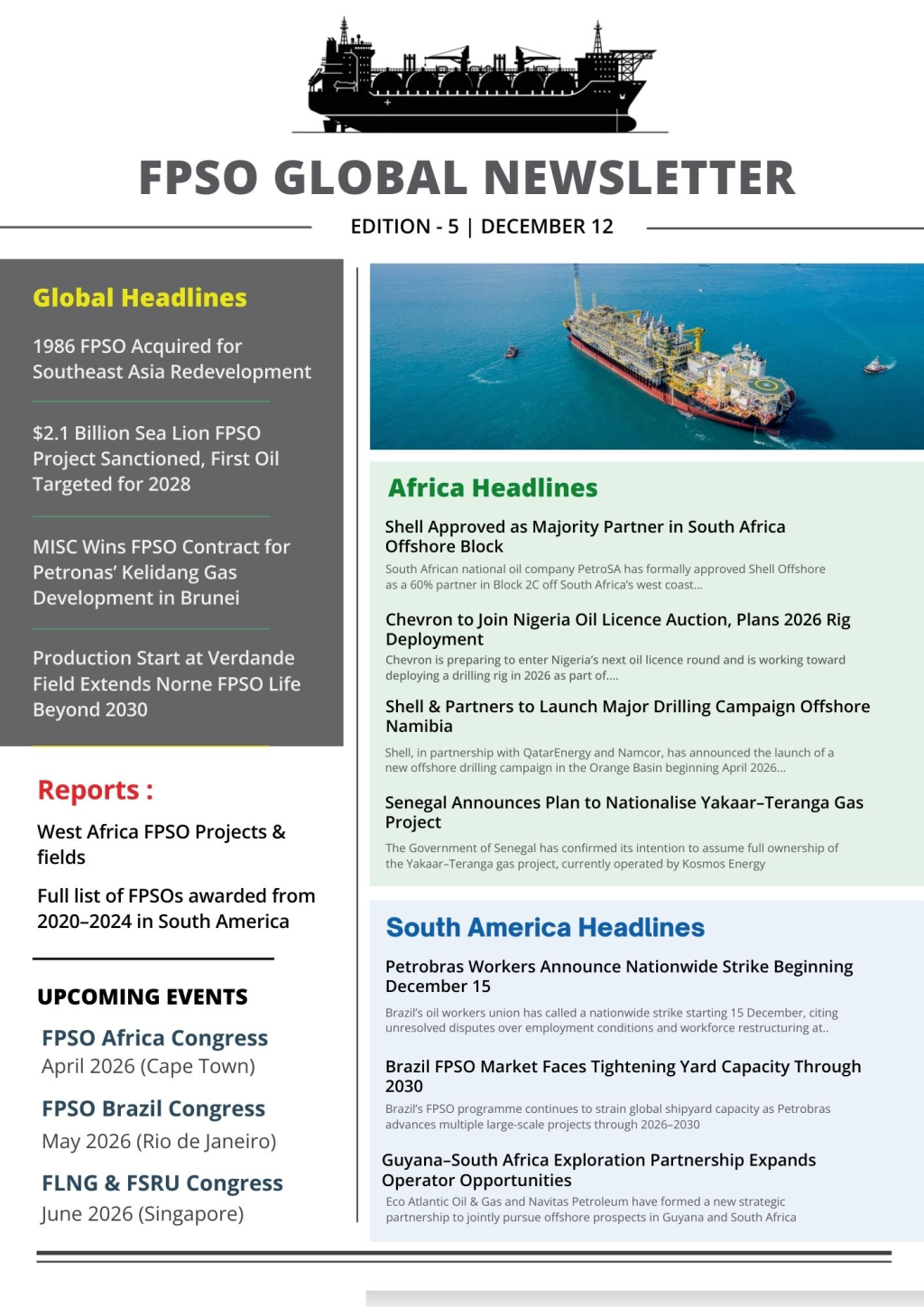
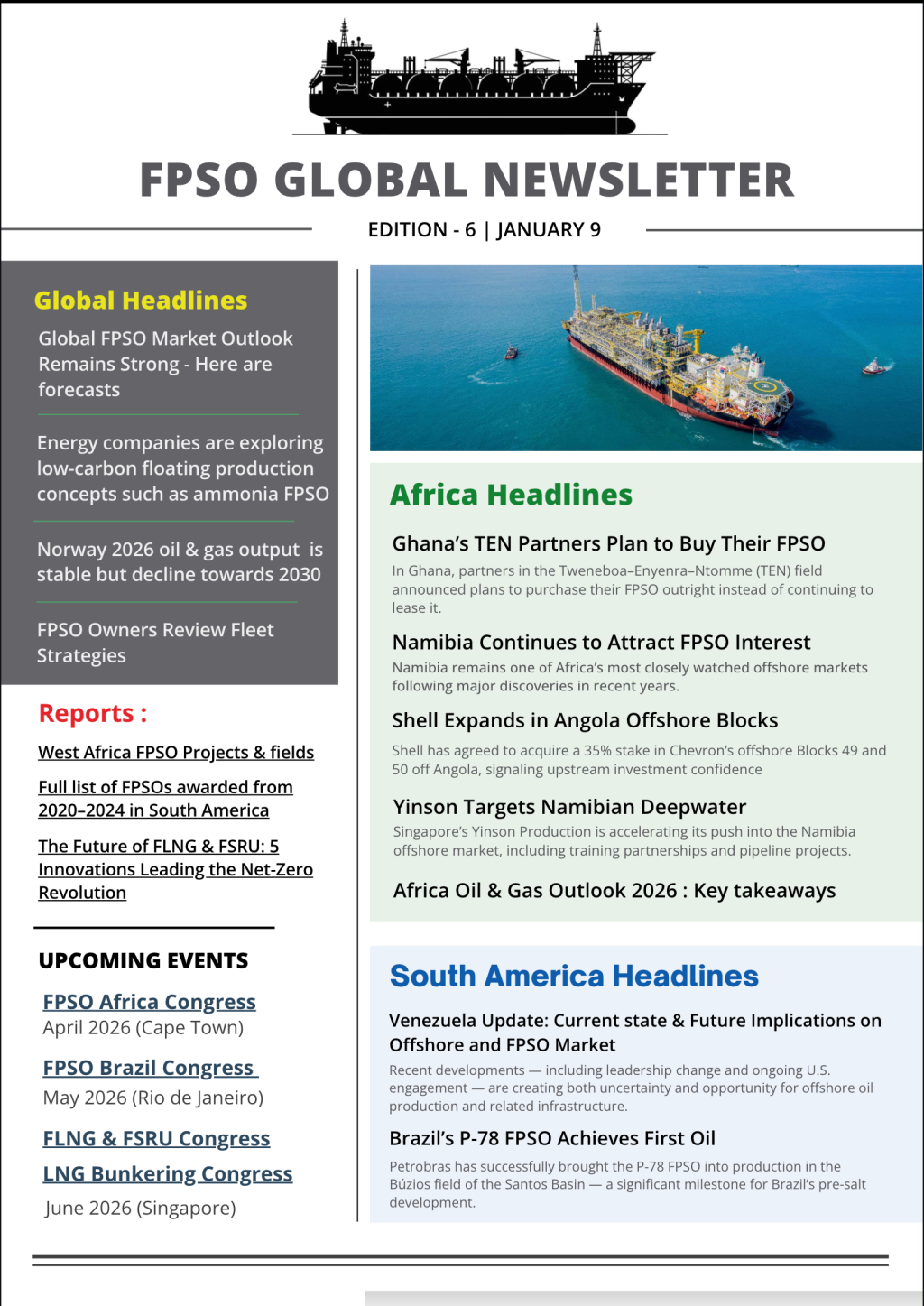
Edition 6 | Global & Africa FPSO Outlook 2026 and Beyond — and What Venezuela’s recent developments means for Offshore & FPSO industry
As we enter the new year, the global FPSO market is not slowing down — it is becoming more selective, disciplined, and strategically focused. Offshore investment remains resilient, but the factors driving FPSO demand are evolving rapidly. In Edition 6, we covered
1. Global and regional FPSO headlines (South America & Africa)
2. FPSO market outlook and forecasts for 2026 and beyond
3. Venezuela’s oil & gas sector: current state and future implications
4. Africa’s role in the next phase of FPSO deployment
5. Key industry reports and events shaping market direction
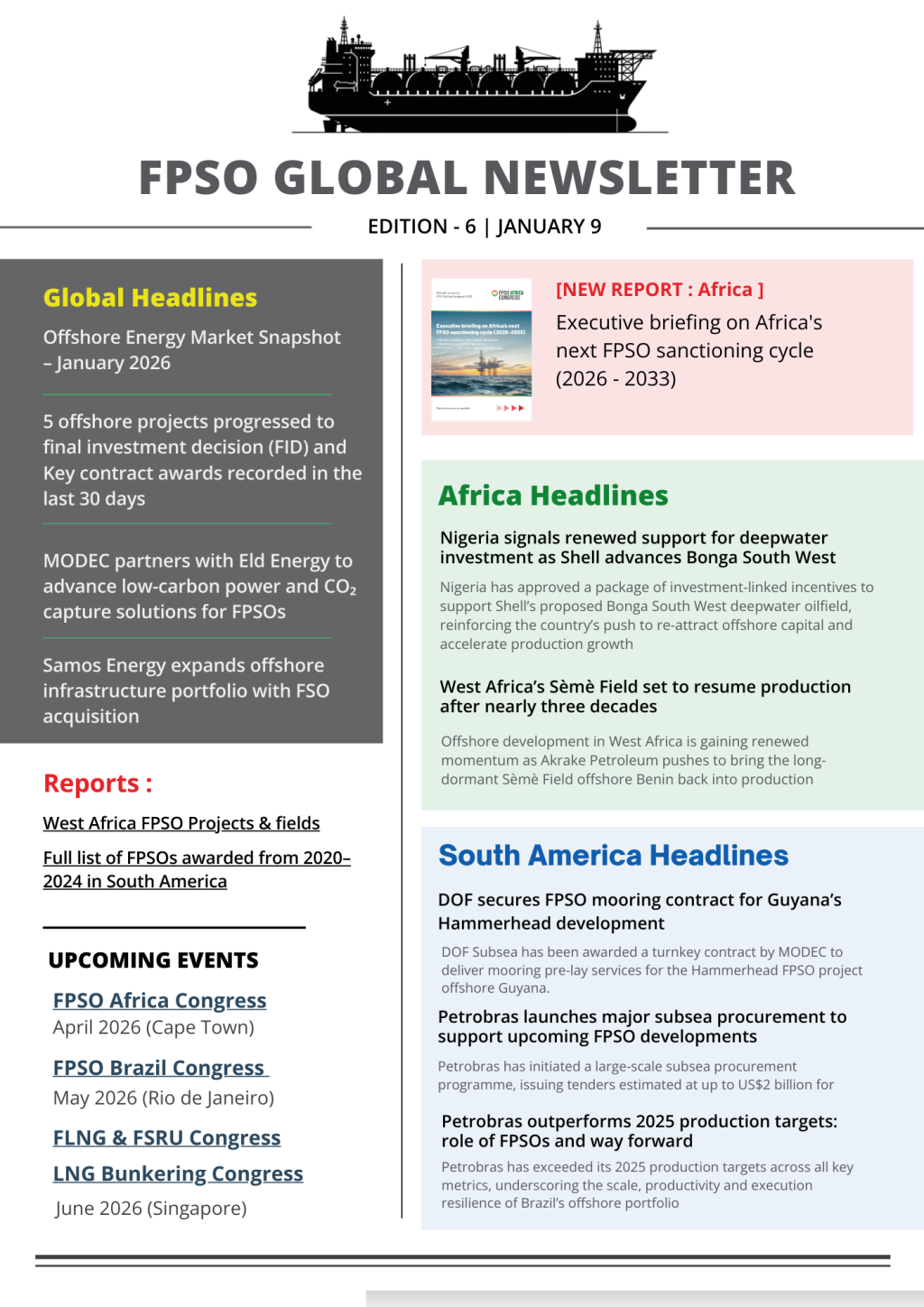
Edition -7 | DOF secures FPSO mooring contract for Guyana, Petrobras outperforms 2025 production targets and more
In Newsletter Edition 7 we covers latest World, Africa and Brazil headlines including:
> Deepwater investment signals from Nigeria, as fiscal incentives clear the path for Shell’s Bonga South West development
> West Africa’s offshore revival, with Benin’s long-dormant Sèmè Field set to resume production after nearly three decades
> Where FPSO and subsea capital is being committed, with recent contract awards pointing to near-term execution priorities
> Petrobras outperforms 2025 production targets: role of FPSOs and way forward
> Fresh market intelligence and reports, tracking FPSO awards, recent FIDs, and Africa’s next FPSO sanctioning cycle (2026–2033)
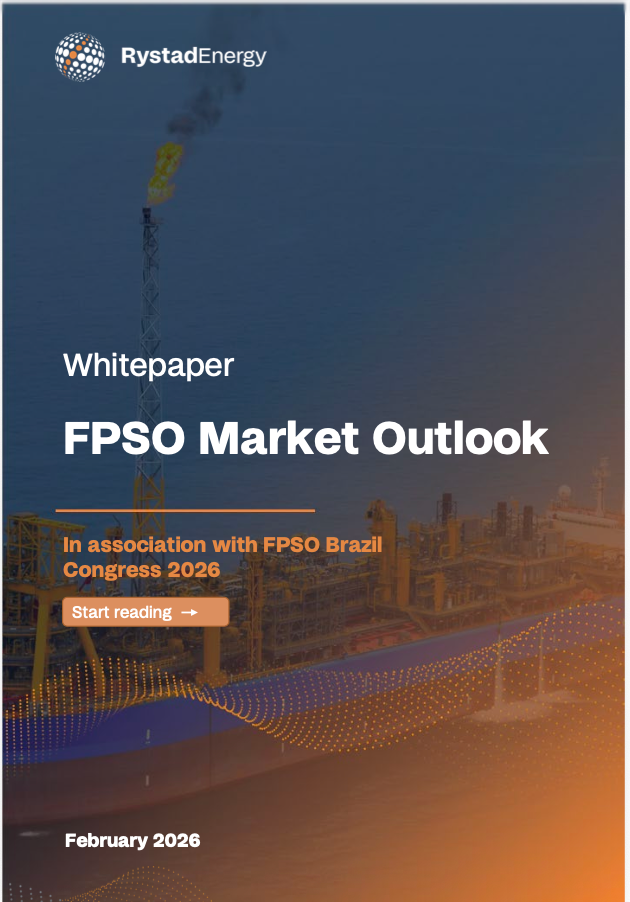
South America’s $112B FPSO Pipeline: Projects Awarded, Leading Regions and Key Operators
South America continues to anchor global FPSO activity, with 21 units awarded between 2021 and 2025 - accounting for more than $112 billion in greenfield capital.
The region’s project pipeline remains robust, as Rystad Energy projects roughly four new awards per year through 2028, representing an additional ~$53 billion in commitments. Against this backdrop, this report examines how award activity is unfolding across the region.
✔ FPSO awards split by region
✔ Brazil’s greenfield capex outlook - and what it signals for offshore spending
✔ FPSO awards expected between 2026–2028, segmented by major region and company
✔ Newbuild vs. conversion trends shaping contractor strategy
✔ Share of FPSOs awarded in South America (2021–2025), by build type, oil capacity, and storage capacity
✔ And more..
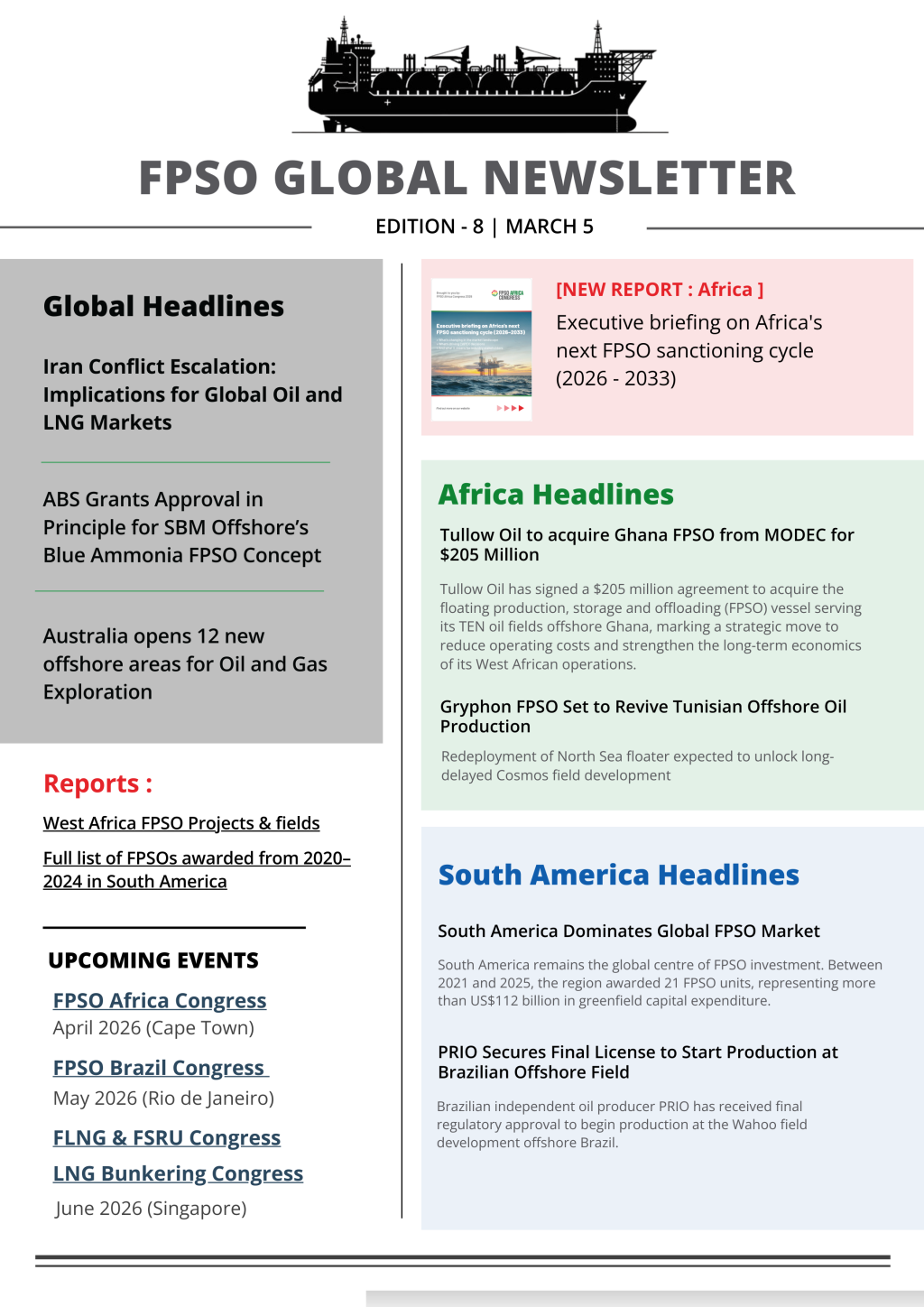
Edition 8 | Iran Conflict Implications for Global Oil & LNG Markets, Tullow’s $205M Ghana FPSO Deal, South America’s FPSO Boom & More
In Newsletter Edition 7 we covers latest World, Africa and Brazil headlines including:
> Iran Conflict Escalation: Implications for Global Oil and LNG Markets
> Tullow Oil to acquire Ghana FPSO from MODEC for $205 Million
> South America Dominates Global FPSO Market
> ABS Grants Approval in Principle for SBM Offshore’s Blue Ammonia FPSO Concept
> Australia opens 12 new offshore areas for Oil and Gas Exploration
> PRIO Secures Final License to Start Production at Brazilian Offshore Field

Inside FPSO Brazil Congress 2026: What the Industry Is Saying
FPSO Brazil Congress 2026 brought together operators, contractors, and solution providers to tackle the next chapter of floating production in Brazil. In this post-event report, hear directly from the industry on the themes that defined the congress — from next-generation FPSO design to the collaboration needed to move projects from concept to delivery. Download the full report for key takeaways, standout sessions, and the conversations shaping what comes next.

FPSO Brazil Congress 2026 Attendee list
Find out who's attending the FPSO Brazil Congress 2026!
Attending companies include Petrobras, TotalEnergies, Equinor, BP, ExxonMobil, Shell, Yinson and many more.
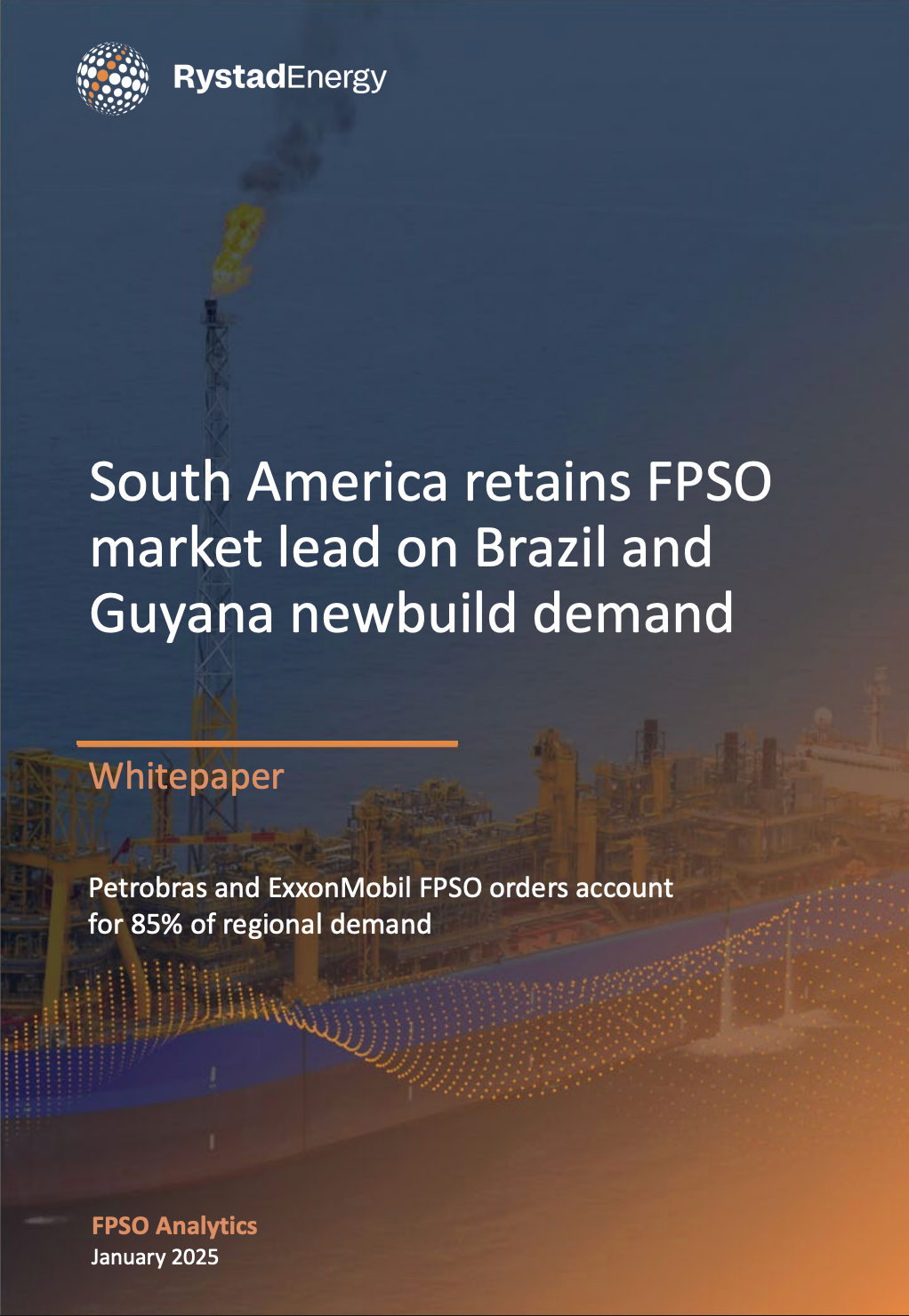
South America FPSO Projects Outlook 2025 – 2029 : Awards, Operators and Newbuild Activity
South America continues to dominate the global FPSO landscape, awarding nearly half of all new floating production units over the past five years. With Petrobras and ExxonMobil responsible for more than 85% of regional FPSO demand, Brazil and Guyana have firmly established themselves as the center of gravity for the next phase of deepwater and ultra-deepwater expansion. This report provides a comprehensive view of FPSO awards from 2020–2024 and outlines expected activity from 2025–2029.
What’s Inside the Report:
> Full list of FPSOs awarded from 2020–2024
> Expected FPSO contracts by field operator, 2025-2029
> Forecast of FPSO awards expected globally and in South America
> Future hotspots: Falkland Islands, Suriname, Santos Basin Trends in newbuild vs redeployed FPSOs

FPSO Analytics: Market Overview of South America
South America continues to dominate the global floating production storage and offloading (FPSO) market, awarding nearly half of all global floater contracts in the last five years. Despite the rise in refurbished, relocated and reused FPSOs since early 2022, the region continues to favor the deployment of newbuild units, especially for large-scale projects in Brazil’s ultra-deepwater pre-salt polygon and offshore developments in Guyana. View the report to find out more

South America: An FPSO Hotspot
The South American region is the global leader in the floating production, storage and offloading (FPSO) segment, both in terms of active platforms and future projects. There will be an average of four FPSOs commencing operations in the region annually over the next five years, driven by developments in Brazil and Guyana, accounting for about 42% of the total global projects involving this type of platform. More than 80% of South American projects that will start operations between 2024 and 2028 are in Brazil, mainly operated by Petrobras.
Download the Report to find out more about FPSO Projects in South America. Join the Upcoming FPSO Brazil Congress 2024 happening on 21 - 24 May as we explore project fundamentals with South America's Oil & Gas leaders.

FPSO Market Challenges and Project Fundamentals in Brazil
Ahead of the FPSO Brazil Congress 2024, leading energy research and business intelligence company Rystad Energy has published the market report “FPSO Market Challenges and Project Fundamentals in Brazil” The offshore upstream segment will play a significant role in meeting oil and gas demand for the coming years, which keeps the relevance of offshore rig vessels, subsea, floating production storage and offloading (FPSO), and other offshore service segments. After several years of decline, the offshore oil and gas industry is entering a new era of investment as of 2022. Offshore capital expenditure (capex) increased 15% in 2023 and is forecasted to grow 12% next year, achieving a level of $93 billion.
The Shift to Chinese Valves in FPSO Construction
The global market for floating production, storage and off-loading vessels (FPSOs) is undergoing significant structural change. As newbuilds and conversions proliferate, particularly in the Asia-Pacific region. The upstream supply chain is likewise evolving. One of the most notable trends is the growing adoption of valve packages manufactured in China instead of the traditional sourcing from European valve OEMs.
Download our whitepaper which details the shift towards Chinese Valves in FPSO Construction - produced by our sponsor Valves & Piping Asia Pte Ltd

Brazil & Beyond: The Evolution of FPSO Projects in South America
South America will remain a key region in the offshore oil and gas sector, especially for deep and ultra-deepwater projects, where regional spending could total around $170 billion across the offshore supply chain. A significant share of this investment will be allocated to projects in Brazil, especially those operated by Petrobras. Rystad Energy and FPSO Network has produced a report to showcase the potential for a significant surge in sanctioning of floating production storage and offloading (FPSO) projects over the next five years, following a slowdown in 2024.

What Makes FPSO Redeployment Difficult
FPSO redeployments are one of the key features that make FPSOs cost effective solutions for field developments, however this strength has been undermined by a growth in inefficiency. Now, the real barriers to successful vessel redeployment lay not so much in the expected technological challenges but instead, in the inflexibility regarding specifications, the lack of shared risks between stakeholders and the distrust present in the operator contractor relationship.

The Seven Point Funding Checklist
Projects will continue to be mooted and securing finances is the first step on the road to commission and deployment. In consultation with veteran FPSO and financial professionals alike, we have put together a checklist of how to secure the cold hard cash needed to get your FPSO project off the ground in this adverse commercial climate.

How can we balance CAPEX and OPEX?
For many in the FPSO industry the issue of balancing CAPEX and OPEX remains a thorn in their side.
FPSO projects are resource-intensive with high CAPEX on top of high operating and maintenance costs (high OPEX). This puts pressure on the industry to continuously evolve the business models and tap into innovations to achieve commercial success. What can projects do to balance the CAPEX and OPEX?
We spoke with Eduardo Chamusca de Azevedo, Country Director – SBM Brazil and Felipe Baldissera Gabriel, Commercial and Contracts Manager, MODEC to get their thoughts.

Maintaining Vessel Integrity & Operational Excellence
IQPC and the FPSO Network conducted an in-depth industry survey with our global community to provide a holistic and well-balanced benchmark when it comes to vessel integrity and FPSO operations. We hope you find this report useful.
In this report, we will look at:
- Mid-Late Stage FPSO Life-Cycle & Operations
- Industry benchmark - Asset Integrity Challenges
- Industry benchmark - FPSO Vessel Maintenance Works
- Industry benchmark - Maintenance Costs & Budget
- Technology - Future of Vessel Integrity Management & FPSO Operations

Unlocking Brazil's Offshore Wind Potential
With FPSO Brazil Congress 2023 returning this year, we are excited to bring you our latest article on Unlocking Brazil's Offshore Wind Potential.
This report was produced in collaboration with Gustavo Ferreira, Project Developer at Corio Generation, and the teams from Corio Generation and Servtec.
Grab your free copy of this article to find out more about:
- Brazil's offshore wind industry - with increased investment from oil & gas operators
- Future opportunities for offshore wind in Brazil - including job opportunities
- The biggest factors preventing the widespread adoption of offshore wind in Brazil

Realizing Greener and Low-Manned FPSOs in Brazil
Ahead of the FPSO Brazil Congress, we spoke to industry leaders to find out what is driving the growth of projects in the region, trends affecting the market and challenges of low-manned vessels.
Insights and feedback were provided by:
- Bruno Azevedo Liberato, Maintenance and Planned Shutdown, Petrobras
- Francisco Eugenio Magarinos Torres, Development and Production Coordinator, Pre-Sal Petroleo SA
- Rafael Torres, Business Development Director, SBM Offshore
- Jorge Luiz Uchoa Mitidieri, VP Executive, Ocyan
Grab your copy of this exclusive market insights report!

2023 Brazil Market Outlook - Rystad Energy Report
Optimizing developments while boosting exploration: How Brazil can make the most of its resources amidst the energy transition
In this special Rystad Energy outlook on the upstream sector in Brazil, we will first focus on the outlook for upstream resource replacement, and how the country needs to fast-track exploration of its undiscovered resources to boost resilience and examine its current pipeline of oil and gas projects up for sanctioning.

How international players can navigate the Brazilian FPSO market
Brazil is one of the world’s foremost Oil and Gas leaders. The previously “closed” economy is now open to the world thanks to new local content policy and regulations set in place.
Here we explore the latest local content updates and what it means for the international market in regard to project execution models and working with local teams.
We also talk with Pietro Ferreira, Senior Regional Analyst at the Energy Industries Council’s (EIC) regional office in Rio de Janeiro about his take on the local content requirements and regulatory changes occurring in Brazil.
Download the article to read more.

How to Fast-Track Projects in the Brazilian Market
Brazil is seen to be a key driver of the FPSO market over the next few years. Therefore to maximize this window of opportunity, project execution and development need to be fast-tracked as much as possible.
With input from industry leaders in the Brazil market, we explore different ways in which the industry can do so.
Download the article to learn more.
In Partnership With:

QUESTIONS?
Contact us via email at enquiry@iqpc.com.sg.

©2026 IQPC. All rights reserved.