Featured Content

FPSO Asia Congress Attendee Overview
Learn more about the attendee profiles of industry leaders that will be attending FPSO Asia Congress. From FPSO Operators, to Oil & Gas Producers, and Solution Providers, these are the list of attendees that you will get to network with at the event.
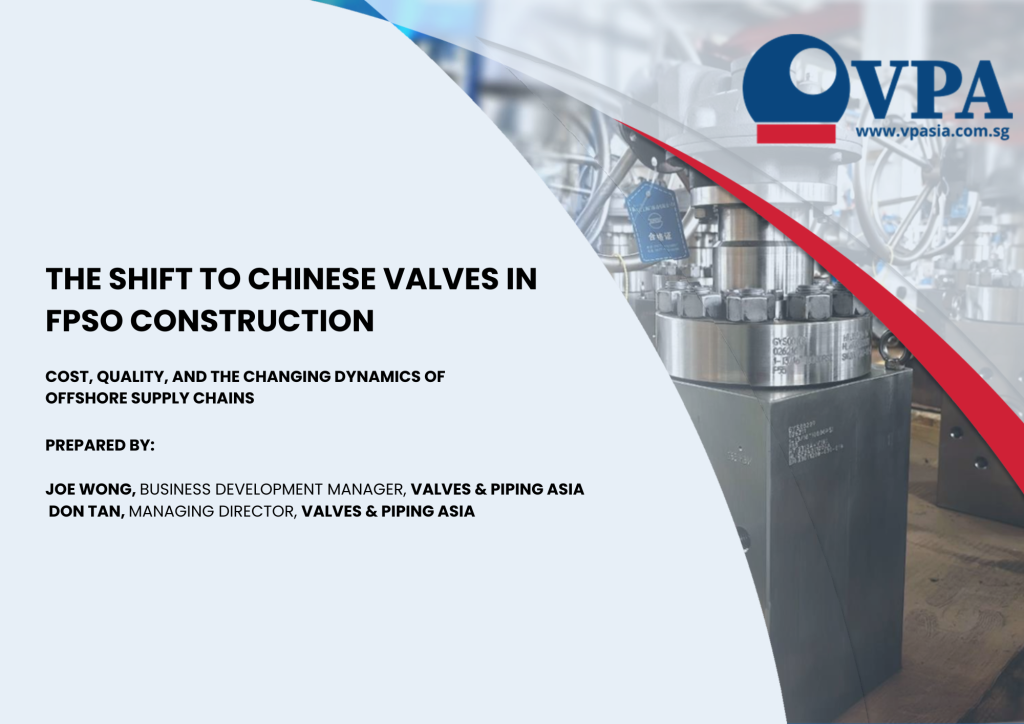
The Shift to Chinese Valves in FPSO Construction
The global market for floating production, storage and off-loading vessels (FPSOs) is undergoing significant structural change. As newbuilds and conversions proliferate, particularly in the Asia-Pacific region. The upstream supply chain is likewise evolving. One of the most notable trends is the growing adoption of valve packages manufactured in China instead of the traditional sourcing from European valve OEMs.
Download our whitepaper which details the shift towards Chinese Valves in FPSO Construction - produced by our sponsor Valves & Piping Asia Pte Ltd

Sustainable Solutions for FPSOs
The oil and gas industry has a critical role to play in reducing global greenhouse gas emissions, as a significant share stems from the upstream production of oil and gas. From a regulatory standpoint, several countries and regions, particularly in Europe and North America, are implementing policies aimed at curbing emissions from upstream operations. Driven by tightening emissions regulations and rising interest in alternative fuels across multiple industries, demand is increasing not only within traditional shipping but also in offshore segments, creating both opportunities and competition between sectors for access to low-carbon fuels

FPSO Supply Chain Strategies
Expenditure in offshore upstream projects has increased in recent years. However, 2023 closed with fewer approvals for FPSO projects than expected. High interest rates and full contractor backlogs proved hurdles for the market. Investment forecast for the next five years proves to be promising as FPSO growth is estimated to increase by 40% compared to the previous period.
Check out the report put together by Rystad Energy on FPSO Supply Chain Strategies.

Future Ready FPSO Projects
Carbon emissions from the FPSO sector are poised to surge amid a flurry of new deepwater developments, increasing concerns on the topic. Carbon dioxide (CO2) emissions are estimated to grow 27% by the end of the decade only in projects with that type of platform. FPSO decarbonization is receiving significant attention, with multiple available technologies to reduce field carbon footprint. Adopting these technologies will decrease the intensity from 19 barrels of oil equivalent (boe) to 17 boe produced by 2030. Check out our report to find out how FPSO projects can be future-ready designed to meet lower carbon emission objectives

2025 FPSO Market Outlook
With a slowdown in FPSO sanctioning activities last year, Rystad Energy projects a significant uptick over the current five-year cycle to near post-pandemic levels. This will be driven by both new developments and redevelopments – many of which were delayed due to volatile oil prices, a strained supply chain, challenging project financing in the energy transition context and the ongoing cost inflation.
Check out the report to learn more about the FPSO Market Outlook for 2025!

FPSO Contractor's Guidebook
FPSO Network has put together an essential easy-to-digest guidebook to some of the biggest FPSO contractors. Understand more about their strengths and benefits, operational track records, execution models, and get in touch with their unique insights on the potentials of the industry
In Partnership With:

QUESTIONS?
Contact us via email at enquiry@iqpc.com.sg.

©2026 IQPC. All rights reserved.